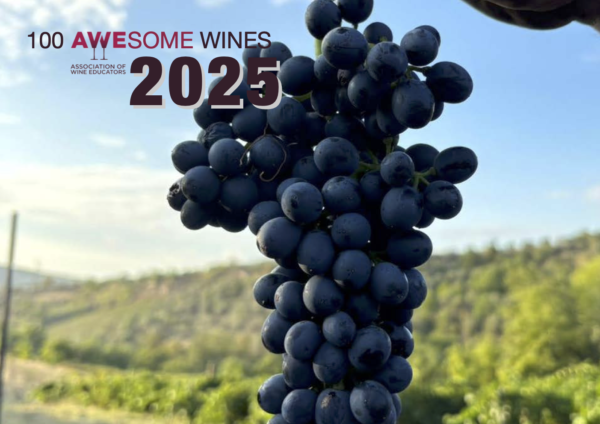
Recently, a group of AWE members enjoyed a fabulous trip to Alsace organised by Linda Simpson, Helen Savage and Nina Cerullo, supported by Foulques Aulagnon, Export Marketing Manager at the Comité Interprofessionnel des Vins d’Alsace (CIVA). We tried a fascinating range of wines across nine producers, as well as working our way through the wine list at our hotel restaurant!
Most, if not all, of the attendees were huge fans of, and knowledgeable about, the region already. Even so, there was so much to learn. However, amongst discussions about soil types, field blends, sustainable viticulture and topography, we also heard how challenging the market conditions are for Alsace producers. It’s the same everywhere, of course: global conflict, trade wars, economic uncertainty, rising costs and changing consumer preferences, not to mention the new duty regime in the UK, are affecting everyone in the wine supply chain.
In light of this, I decided to carry out a SWOT analysis on Alsace wine. Below you’ll find a summary table of what I’ve identified as its strengths and weaknesses, the opportunities it could grasp and the threats it faces. I will then go on to look at the points in further detail.
Summary: A SWOT Analysis of the Alsace Wine Industry
STRENGTHS
|
WEAKNESSES
|
OPPORTUNITIES
|
THREATS
|
Strengths
One of Alsace’s key strengths is its natural beauty. Vineyards cling to the scenic Vosges mountains, providing a striking backdrop to picture-postcard villages. It’s perfect for marketing materials, communicating the link between the wine and its origins. It also makes Alsace a great place to visit, even for the less “wine-involved” tourist.
The Route des Vins was established in 1953 and is unquestionably the most established and tourist-friendly in France, and on a par with other leading wine tourism destinations in the world. Winding through about 120 villages with some 720 producers open and welcoming to visitors, the route has a website that makes it easy to plan anything from a day out to a longer trip. It is well signposted and there’s a separate cycle route. There’s even a good bus network linking many of the top villages. We’re told that marketing is all about the experience these days and the Alsace wine experience is unique. It’s not surprising that cellar doors accounted for a quarter of total sales in 2024 and, for some producers, that figure is much higher.
Alsace’s uniqueness is due in no small part to its “double culture”. Until the end of the Second World War, the region ping-ponged regularly between being part of France and Germany (Prussia). This explains the distinctive feel and look of the region plus the taste and smell of its wine and cuisine. It also accounts for the distinctive flûte bottle. Many wineries are storied, having been in the same family for generations. A unique proposition, a compelling story and distinctive packaging are all vital marketing tools.
History and longevity create trust in consumers’ minds, as does a well-established appellation system. AOC Alsace was created in 1962, the first grand cru in 1975, and AOC Crémant d’Alsace in 1976.
Much is made, rightly, of Alsace’s diverse terroir. The Vosges and the side valleys offer a wide range of microclimates. And Alsace famously is one of the driest and sunniest places in France (although, as we discovered, it definitely does rain there!). This contributes to the beautifully ripe fruit and also enabled Alsace to pioneer organic viticulture in France, with over 40% of the total vineyard area now certified as either organic or biodynamic.
But it’s the legendary patchwork of almost every type of soil imaginable that really creates the wide variety of wine styles: crémant; whites from light aperitif wines to complex, ageworthy wines; naturally sweet wines and Pinot Noir. There’s a wine to pair with almost any type of food; few regions offer such diversity. And, unlike in any other major wine region in France, wines can be varietally labelled, something that has been fundamental to the growth of non-European wine regions.
Weaknesses
However, it’s not all sunshine and roses (indeed, sales of the rose-scented Gewurztraminers have been in steady decline). Many of these strengths carry their own weaknesses.
For example, as reassuring as the various PDOs may be, a general criticism of these is that they are inflexible and limit innovation. Pinot Noir is currently the only permitted black grape variety, which is not ideal in the face of rising temperatures.
The grand cru system is fraught with issues too. In most cases, grand cru wines can only be made exclusively from one of the four “noble” varieties (Riesling, Pinot Gris, Gewurztraminer and Muscat), and whilst we tried a couple of excellent dry Muscats, are these really the most expressive Alsatian wines? A few grands crus (they became PDOs in their own right in 2011) now allow blending and additional grape varieties – with the long overdue inclusion of Pinot Noir in an increasing number – but there is a long way to go.
Does grand cru labelling even guarantee the best wines? Many cover a significant area with a wide range of terroir, making it hard to pin down a particular style or characteristic. Also in 2011, PDO Alsace permitted the names of specific smaller sites (known as lieux-dits) on labels, and it is anticipated that these could form the basis of a new premier cru designation. Yet, for consumers who struggle to recognise the 51 grands crus, this can only make things even more complicated.
Another longstanding labelling issue has been how consumers can know whether they are buying a dry or sweet Alsatian wine. Historically, labels offered no clues. Since the 2021 harvest, a new standardised indicator of sweetness is required on all PDO wines, but this has not been without controversy, with producers of off-dry Rieslings feeling disadvantaged.
Continuing the theme of weaknesses within strengths, whilst there is certainly a long history of winemaking in Alsace, the modern wine industry really only began post-WWII, putting it on a par with regions such as California. Under German occupation, wineries were encouraged to plant productive but lower-quality German hybrid varieties, and it was only after the war that focus once again turned to the noble varieties. It is little wonder then that the characteristics and qualities of the myriad soil types are still not fully understood.
Also, that distinctive bottle shape poses its own problems: it doesn’t fit as easily into wine racks or packaging as conventional bottles. That might be one reason why the requirement to use flûtes was relaxed in 2024. And whilst the varietal labelling is a modern approach, there is no denying that the design of many of those labels are old-fashioned and don’t appeal to modern consumers.
The steeper vineyards are labour-intensive to farm, with limited scope for mechanisation. This adds to production costs and poses logistical challenges with the ever-decreasing availability of labour.
Another major problem is the wines’ reputation, particularly on the French market. Outside the region, Alsatian wine is too often treated as a cheap option, really only suitable for an apéritif. This may go some way to explaining why higher-quality wines are hard to find in other parts of France, even in Paris. They are not that easy to source in the UK either.
Threats
Breaking with convention, to save the best for last, before opportunities I will look at the threats faced by the Alsace wine industry. As in so many wine regions today, climate change is top of the list. Winemakers told us that “normal” vintages are a thing of the past, as may be Séléction de Grains Nobles, since warm, dry autumns are unsuitable for the formation of botrytis. The valley floor is becoming too hot and too dry for viticulture.
Hot temperatures close to harvest mean that even a day or two’s delay can result in overly ripe grapes. However, Olivier Humbrecht argued that we cannot blame the climate for this; it is the grower’s fault for not getting the logistics of harvest right: for example, insufficient access to presses, lack of vat space, and too few workers. Yet, as noted above, labour is in short supply.
Due to rising temperatures and low rainfall, the valley floor sites – historically the easiest and cheapest to farm – have become much less suitable for viticulture and are starting to be pulled up. Even in the grand cru sites, vineyards are falling into disrepair, as younger generations are less interested in taking on family wine businesses. Not everywhere is as fortunate as Domaine Schoenheitz, which, having been sold by the family a few years ago, we found to be in very safe hands.
Ever-rising operating costs are squeezing margins ever tighter – and it remains to be seen what effects a global trade war might have on Alsace: for example, in 2024 the USA was Alsace’s second-largest export market. Faced with these diminishing margins, Olivier Humbrecht reckons that vineyard holdings of 7ha are no longer sufficient to be financially viable – though Agathe Bursin with her 7ha would doubtless disagree!
Finally, consumer tastes are changing. Health-conscious consumers are turning away from higher-alcohol wines and those with residual sugar (although production of both is falling in Alsace). Sales of Gewurztraminer have been falling, partly for this reason and partly, according to Olivier Humbrecht, due to the demise of the cheese course – it being a perfect pairing with the local Munster cheese.
Opportunities
Nevertheless, there are many opportunities that Alsace could exploit, and what follows is by no means a comprehensive list.
To mitigate against climate change, a number of the wineries we met are already experimenting with warmer-climate varieties. Several are trialling Syrah, with positive results. Italian varieties such as Nebbiolo are being trialled at Zind-Humbrecht, and Viognier at Pierre et Frédéric Becht. The region is petitioning the INAO to allow the introduction of additional varieties under PDO rules in the same way that other regions, notably Bordeaux, have done.
Eddy Faller at Domaine Weinbach thinks an increase in blending and co-fermenting will be a useful tool in the face of climate change, especially for grapes that ripen at different rates, such as Pinot Gris and Pinot Blanc. Of course, at the moment, these wines could not be labelled grand cru. He stopped short of suggesting field blends of different varieties grown and picked together, as eloquently advocated and brilliantly executed by Jean-Michel Deiss.
Numerous wines within the Alsace portfolio fit well with current consumption trends. Crémant d’Alsace is well-placed to ride on the crest of the sparkling wine wave. Sparkling wines accounted for 36% of total Alsace wine sales in 2024, having shown 20% growth in the last five years. Recent OIV data shows that white wine consumption is also rising. According to CIVA, Alsace Riesling sales have been growing. Our group tasted, and discussed generally, how good Pinot Blanc can be. And with the increased interest in white blends such as Gemischter Satz, might it be time to push higher-quality Edelzwicker?
There is still plenty of opportunity for innovation, beyond simply planting new varieties. Domaine Frédéric Mochel is experimenting with clay amphoras, whilst Schoenheitz is trialling Pinot Noir aged in a mulberry barrel. Skin contact wine is on the rise, and many of Alsace’s permitted varieties lend themselves to this style. And we’re not just talking “orange” wine either: we tried Becht’s extraordinary Pinot Gris Rubis, which, after 3-4 weeks on the skins, was the colour of Pinot Noir. Speaking of which, Alsace has the potential to tap into rosé’s continued popularity: at the moment, it’s rare and undervalued.
The warm, dry climate of Alsace lends itself to lower-intervention wines. “Natural wines” have been very popular in France, and there are numerous producers, such as Domaines Rieffel and Vincent Stoeffler, the latter producing both low-intervention and more conventional wines to satisfy both markets. More and more producers are looking to achieve organic or biodynamic certification (though as this has become more commonplace, is it really a USP any more?).
Alsace should look at growing into new markets, especially if existing ones become problematic. Southeast Asia is currently a growing market, and certain Alsace wines are known to pair well with that region’s food. There’s also the possibility of exploiting new sectors of existing markets. Foulques spoke of CIVA’s desire to increase sales of higher-quality wines in the UK, and areas of France outside the region, notably Paris, should also be considered. As part of this, I wonder whether Alsace could do more to promote the terroir of its wines. The labels from Domaine Marcel Deiss provide an artistic interpretation of their individual vineyards, but more matter-of-fact explanations of the effects of the different soils could interest higher-end consumers.
It would be good to see more examples of innovative labelling along the lines of Deiss. The region should also not be afraid of moving away, to some extent, from the traditional bottles. However, it’s this balance of the traditional and the modern, alongside its “double culture”, which serves Alsace so well, and should continue to do so.
Tags: Alsace cremant Gewurztraminer Muscat Pinot Blanc Pinot Gris Pinot Noir Riesling wine business wine trip